




Moving With Pets in the Twin Cities: A Practical Guide
By Jim Jones, Operations Manager, Good Stuff Moving · Serving the Minnesota and St Paul · Last updated: August 6, 2026
Quick Answer
Moving with pets in Minnesota takes more than packing a carrier. You’ll need proof of rabies vaccination and, in most cases, a Certificate of Veterinary Inspection to bring a dog or cat into the state, a plan for pet deposits at your new place, and a cold-weather strategy if your move date falls between November and March. Here’s what our crew tells every pet-owning client who’s moving with pets around the Twin Cities.
Key Takeaways
- Dogs, cats, and ferrets three months or older need current rabies vaccination and, in most cases, a Certificate of Veterinary Inspection (CVI) to enter Minnesota from another state.
- Minnesota has no statewide cap on pet deposits. Landlords set their own amount, so budget for it before you sign a lease.
- Below 20°F, most dogs shouldn’t be outside more than 15 minutes. Frostbite risk climbs fast on a Minnesota winter move.
- The Twin Cities has 16 off-leash dog parks between Minneapolis and St. Paul, worth scouting near your new address before moving day.
- Rabies and licensing rules can vary by city or county once you’re in Minnesota, so check the ordinance where you’re landing, not just the state rule.
Minnesota’s Pet Import and Rabies Vaccination Rules
This section covers Minnesota pet import requirements start to finish, and it’s worth reading before you book a moving date. If you’re moving to Minnesota with a dog, cat, or ferret from another state, the paperwork starts before the moving truck does. According to the Minnesota Board of Animal Health, dogs, cats, and ferrets moving to Minnesota from another state, visiting for more than 30 days, or changing owners while in the state need a Certificate of Veterinary Inspection (CVI) to enter. Your vet fills this out, and it’s valid for 30 days from the date it’s issued, so timing it to your move date matters.
On top of the CVI, every dog, cat, or ferret three months of age or older traveling into Minnesota must be currently vaccinated for rabies, with the details listed on the CVI itself or attached as a separate, valid rabies certificate. Your regular vet can typically handle both documents in one appointment before you leave your old state.
Here’s the part a lot of pet owners miss: rabies and licensing requirements don’t stop at the state line. Some Twin Cities cities layer on their own ordinances once you’re a resident.

Bloomington, for example, requires dog and cat licensing on top of the state rabies rule. That’s one illustration, not the only one, so check your specific city’s website once you have a new address rather than assuming the state rule is the whole story.
None of this needs to be complicated. The short version: get your CVI and rabies paperwork lined up with your vet before your move date, keep copies in the same folder as your lease and moving contract, and you’re covered for the part of moving with pets to Minnesota that trips up the most people.
Finding Pet-Friendly Housing in the Twin Cities
If you’re hunting for pet friendly apartments in the Twin Cities, the listings love the phrase “pet friendly,” but the fine print on deposits is where things get confusing. You may have read somewhere that Minnesota caps pet deposits at two months’ rent. That’s not accurate. Under Minnesota Statute 504B.178, the state doesn’t set a cap on security or pet deposits at all. It’s negotiated between you and the landlord. What the statute does require: landlords must pay simple interest of 1% per year on the deposit and return it (or a written explanation for withholding it) within three weeks, 21 days, of when your tenancy ends. Budget for whatever the listing asks, and don’t be surprised if it varies building to building.
Service and emotional-support animals are a different category under Minnesota law. Landlords can’t charge pet deposits or pet fees for them, since they’re not treated as pets for lease purposes.
Beyond the deposit, older Twin Cities apartment buildings and condo associations often carry their own weight or breed restrictions on top of what the landlord allows, so it’s worth asking directly rather than assuming a “pet friendly” listing covers your dog’s size or breed. A building can advertise itself as pet friendly and still cap dogs at 35 pounds or maintain a breed list, and that’s a much worse thing to discover after your lease is signed than before. Ask for the pet policy in writing, not just verbally from a leasing agent, and keep a copy with your other move paperwork.
If you’re headed into an apartment movers situation, our crew has handled enough Twin Cities lease-to-lease moves to know which questions to ask your new building before moving day, not after. We can also tell you, from experience, that a same-building or same-complex move is logistically easier on a pet than a cross-metro move, since the new environment carries at least some familiar smells and sounds.
Choosing the Right Movers When You Have Pets in Tow
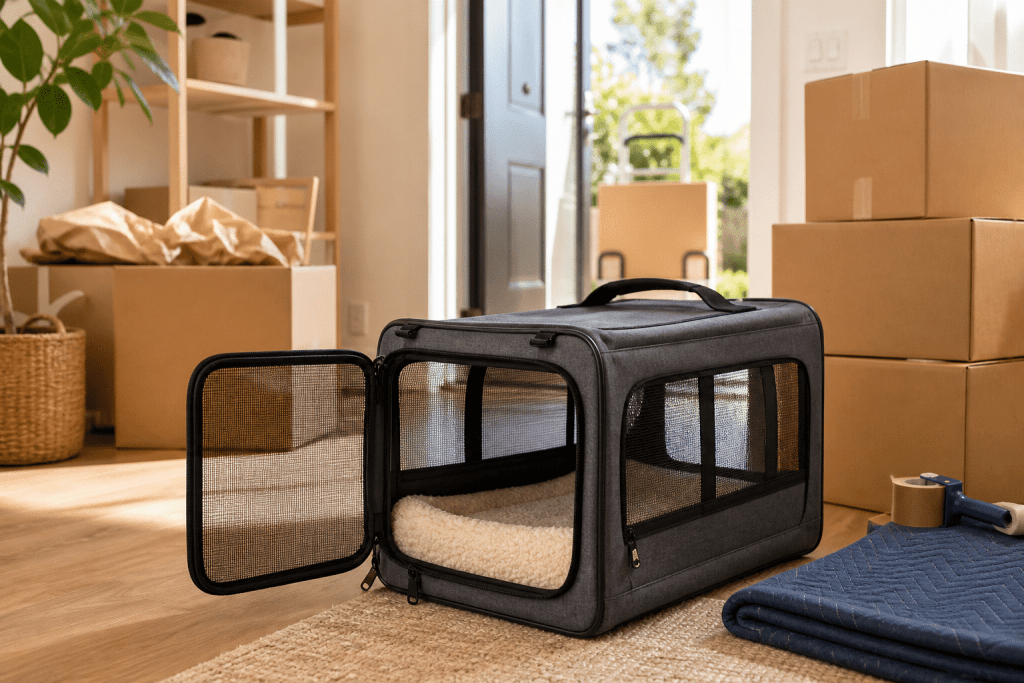
Moving day logistics change the moment a dog or cat is part of the plan. A nervous dog usually does best crated in a quiet room away from the open front door; a mellow cat might do fine supervising the chaos from inside a carrier in a closed bedroom. Either way, it’s worth telling your moving crew up front so everyone’s on the same page before the truck backs up.
It also matters whether you’re making a same-day local move or a multi-day statewide or out-of-state move. A local move means your pet is out of routine for a few hours; a long-distance move means overnight stops, unfamiliar rest breaks, and more planning around food, water, and bathroom time. For a same-day local move, most pets do best boarded with a friend, at a kennel, or crated in a finished room until the truck pulls away, then reintroduced to the new place once the furniture’s in. For a multi-day trip, you’re managing a whole different set of variables: hotel pet policies, rest-stop leash safety, and a cat that’s never seen a hotel room before.
As local movers, we’ve been helping Twin Cities households, and their pets, move for more than 27 years, and the short version is: plan the pet part of the move with the same care you plan the boxes. Whether you need residential movers for a same-day Twin Cities move or home movers for something bigger, our crew works around your pet’s routine rather than the other way around. If your move is crossing state lines, our long distance movers can walk you through what a multi-day trip looks like for an animal that’s never done one before, including realistic timing for rest stops and overnight stays.
Packing and Moving Day: Keeping Cats and Dogs Calm
Use this section as your moving with pets checklist for the day itself. Pack a pet go-bag before you pack anything else, and keep it out of the truck. Food, water, any medications, bowls, a leash, litter and a scoop if you have a cat, and one familiar blanket or toy should all stay with you, not buried in a box that gets loaded first and unloaded last.
On moving day itself, the safest place for a dog or cat is a quiet, already-finished room with the door shut and a sign taped up for the crew, not loose in the house and not riding in the truck. Movers coming in and out with an open front door is exactly the scenario that leads to a pet slipping outside in an unfamiliar neighborhood.
Update your pet’s microchip registration and ID tag with your new address before the move, not after you’ve already unpacked. It takes ten minutes and it’s the difference between a lost pet being a quick phone call or a real crisis. A dog or cat that slips out during a chaotic moving day in an unfamiliar neighborhood, with old contact information attached to its chip, is a much harder recovery than one with current information on file.
If packing everything else is eating your week, our packing services crew can take that off your plate so you’ve got the bandwidth to handle the pet side of the move yourself. We’ve found that clients who hand off the boxes to us are far more likely to actually follow through on the pet go-bag and the quiet-room plan, simply because they’re not also taping boxes at midnight.

Cold-Weather Moves: Pet Safety in a Minnesota Winter
Winter moving with pets in Minnesota is the part of a move that generic pet-moving advice never covers, and it’s genuinely important if your move date lands between November and March. According to veterinary guidance reviewed for Pets Best, once the temperature drops below 20°F, small dogs and dogs with thin coats shouldn’t be outside for more than about 15 minutes, and medium and large breeds shouldn’t be out longer than 30 minutes when it’s between 20°F and 32°F. Wind chill and wet fur make the risk worse, not just the thermometer reading.
During loading and unloading, keep your pet in a warm car or already-heated new home rather than staged outside or in an unheated garage. It’s tempting to let a dog “help supervise” while the crew works, but a Minnesota driveway in January is not the place for that.
After any outdoor stop, wipe down your pet’s paws, legs, and belly. According to the American Veterinary Medical Association and Pet Haven of Minnesota, a Minneapolis-St. Paul animal welfare nonprofit, de-icing products and road salt can stick to fur and paws and make a pet sick if they lick it off, so a quick towel-down after every outdoor break is worth the extra minute.
Winter moving with pets in Minnesota also means planning around the move itself, not just the
walks around it. Movers coming in and out with an open door lets cold air pour into the house fast, so pick one door for crew traffic and keep your pet’s room on the opposite end of the house. If you’re moving into a new place that hasn’t had its heat running yet, ask your movers or a neighbor to get the furnace going a few hours before your pet arrives, especially for cats, who tend to tolerate a cold, unfamiliar space worse than dogs do.
Frequently Asked Questions
Do I need paperwork to move my dog or cat to Minnesota from another state?
In most cases, yes. According to the Minnesota Board of Animal Health, dogs, cats, and ferrets moving to Minnesota from another state, visiting more than 30 days, or changing owners while in the state need a Certificate of Veterinary Inspection, plus current proof of rabies vaccination if your pet is three months or older.
Is there a limit on how much a Minnesota landlord can charge for a pet deposit?
No. Minnesota Statute 504B.178 doesn’t cap security or pet deposits; the amount is negotiated between you and your landlord. The statute does require 1% annual interest on the deposit and its return within 21 days of move-out.
How cold is too cold to walk my dog in the Twin Cities in winter?
According to Pets Best, once it drops below 20°F, small dogs and thin-coated breeds shouldn’t be outside more than about 15 minutes, and medium to large breeds shouldn’t be out longer than 30 minutes between 20°F and 32°F. Wind chill and wet fur shorten that window further.
Do I need to re-register my pet’s rabies vaccination once I move within Minnesota?
Possibly. Rabies and licensing ordinances can vary by city or county once you’re a Minnesota resident, so check with your new city directly rather than assuming your prior city’s rule still applies.
What’s the safest way to keep my pet calm on local moving day?
Confine your pet to a quiet, already-packed room with the door shut and a note for the crew, away from the constant open-door traffic. Our residential movers team is used to working around a crated dog or a nervous cat and can plan the load-out to minimize how long that door stays open.
Should I fly, drive, or hire movers if I’m relocating with pets from out of state?
It depends on the distance and your pet’s temperament, but for most Twin Cities-bound households, driving with a familiar crate beats flying for anything but the longest moves. Our long distance movers team can help you plan a route and schedule that keeps your pet’s stress, and yours, to a minimum.
The Bottom Line
Moving with pets in Minnesota comes down to a handful of real, checkable things: get the rabies and CVI paperwork sorted before you leave your old state, don’t let an inaccurate “capped deposit” claim talk you out of budgeting properly, and take our Minnesota winters seriously if your move lands between November and March. We’ve been helping Twin Cities households, pets included, move for more than 27 years as a family-owned crew, and whether you need local movers, residential movers, home movers, apartment movers, long distance movers, or packing services, we plan around your pet’s routine instead of asking your pet to plan around us. Tell us about your pet when you request a quote; it genuinely helps us plan your day.
About the author
Jim Jones is the Operations Manager at Good Stuff Moving, a family-owned moving company that’s served the Twin Cities Metro for 27+ years. Jim and the crew handle residential, commercial, and long-distance moves across Minnesota with transparent, upfront pricing, when Good Stuff Moving says complete, they mean complete.